I was recently invited to be involved in the day 2 keynote at GitHub universe. I’d asked to be considered for speaking opportunities, but wasn’t expecting to go straight to the main stage!
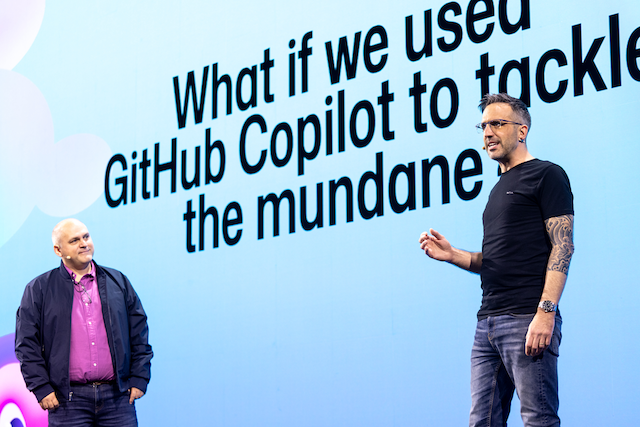
It was a fantastic experience, and I learnt a lot about what goes on behind the scenes to put on a production of that scale. You can see my talk here with Martin - we decided on a conversational style to keep it snappy.
What we ended up was part an initial script I put together that went into a bit more detail. I’m really interested about how AI assisted delivery scales across larger engineering teams, in particular how you involve everyone else in the process who might be less technical and not especially comfortable with working in GitHub.
It’s all about getting the context you need and making sure everyone is thinking about how we can turn ideas into output with the least amount of handover points - here’s my original draft that dives into this a bit further.
The AI-Assisted Development Challenge
Like most of the industry, here at ASOS we are working hard to figure out what the new Software Development Lifecycle looks like in an AI-assisted world.
Over the past few years, we’ve transformed how we host, scale, and deploy software in the cloud. Now, we’re taking on an even bigger challenge: transforming how we actually build and craft software. The pace of change is incredibly fast—every month it seems that new tools and techniques emerge.
But amidst all the change, I believe one truth stays constant: great outcomes come from people working closely together. The only difference is that now, those people are collaborating with AI. But what does that collaboration look like in practice?
Blurring the Handover Points
We think about it through the lens of three familiar roles: Product Managers, Designers, and Engineers. The fundamentals of their jobs haven’t changed. What has changed is the interface between them—the handover points are blurring. Each persona must now be producing assets that can be read, reasoned about, and acted on by AI. That means writing requirements, designing interfaces, and structuring projects with an AI-first mindset from the start.
To enable this, we’ve been connecting the tools our teams already use—Figma, Miro, Confluence, and GitHub—into an integrated flow. We believe that if you want a new process to succeed, you need to give people the tools they’re happy with, where they can do their best work.
For Designers, Figma can integrate through MCP, letting us pull design tokens directly from the source - we’ve seen a demo of that flow here at Universe. For Product Managers, tools like Miro allow for collaborative iteration with teams, and we can export outputs from those sessions into structured documents that AI agents can consume.
GitHub is where your entire product development comes together, bringing all the assets into a single location and giving tools like GitHub Copilot the holistic context they need. This allows AI to reason about the entire project and generate new components, tests, and documentation.
While the tools are essential, the bigger challenge lies in people and mindset. For large organizations, a transformation of this scale requires time, involving hundreds or thousands of people. It’s more than adopting new software; it’s a fundamental shift in the development cycle.
Spec-Driven Development
We’ve structured our approach around what many call “spec-driven development,” which is broken into two core stages:
Plan: Product Managers and Designers create AI-ready assets. The goal is to provide agents with the best context they can act on confidently. They work together with the engineering team to produce the right documents.
Implement: Engineers, in tight collaboration with Copilot and other agents, transform those assets into production-ready code. This feedback loop allows for iteration in hours and days, not weeks.
Admittedly, there are initial barriers to entry to manage, such as security sign-offs, supplier onboarding, setup, and training. Changing an organization and its culture takes time. However, the accelerated capacity we gain from this new process means we must be intentional about how we use it, reinvesting that freed-up time rather than letting it vanish into “hidden” productivity.
Starting with Low-Hanging Fruit
So, how do you immediately demonstrate this value? We’ve found an effective strategy is to target low-hanging fruit—low-risk areas where AI-assisted development can instantly give time back to your teams.
Things like:
- Updating documentation
- Fixing smaller bugs and tech debt
- Automating repetitive internal workflows
- Adding and updating tests - not just about coverage, but finding all the core functionality of your systems. We think investing time into your testing will unlock future agentic flows
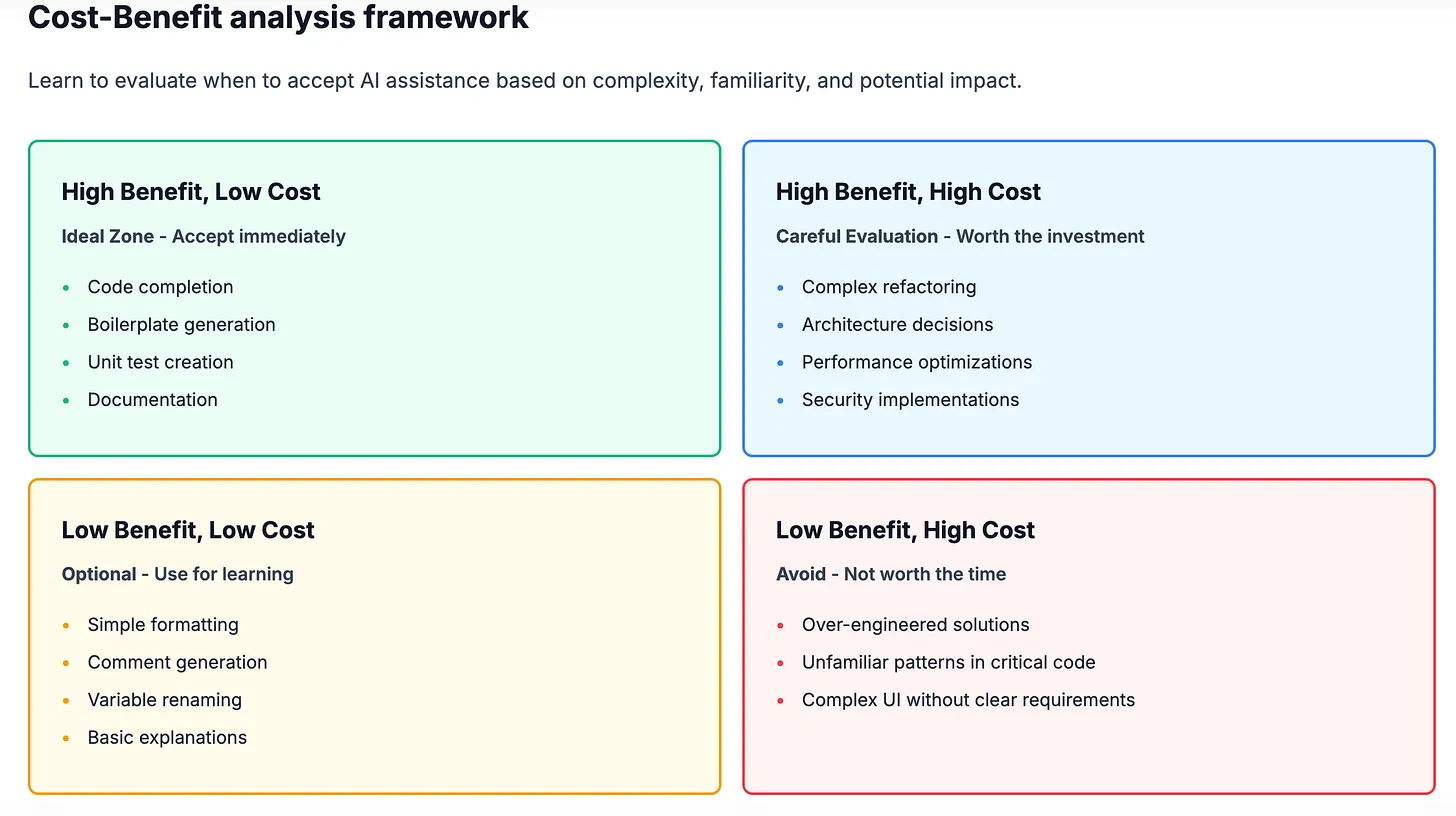
These aren’t the headline-grabbing projects, but they free up capacity, build confidence and set you up for the future. As per this image (Credit to https://beyond.addy.ie/), it’s the High Benefit, Low Cost quadrant.
Internal Tooling: The Perfect Playground
One area we’ve found especially powerful is internal tooling. Internal tools and admin screens are the perfect playground for proving out agentic development flows. They solve real problems for internal users, reduce toil, and improve efficiency. They’re full stack, allowing you to prove out UI, API and data, and carve out vertical slices that play nicely with the spec-driven approach.
Historically, these projects struggled to make the priority list - especially when you have workarounds and runbooks - customer-facing value always came first.
But with AI-accelerated development, you can do both - It’s no longer a question of OR. Now you can say AND. You can deliver the customer work AND build the internal application. You can build internal tools in days. It delivers quick wins while the broader cultural transformation continues. It’s safe, tangible, and builds organizational confidence in AI workflows.
A Real-World Example
We put this into practice to build a solution that identifies and reports missing or mismatched stock transactions. A real problem we were facing, that was burning team time on investigation and reconciliations.
The original MVP estimate by the team was three months, alongside their existing commitments.
Working in a spec driven agentic flow, the total active development time was Eleven workdays for the full engagement - from discovery to system being used. 99% of all code was agentically developed. Despite the team mainly being backend-focused, the UI looks great as the AI helped to level up the engineers React skills.
Overall, we delivered 8 times faster than the original estimate. We ended up with more time than anticipated and delivered more than the MVP; with additional nice-to-have capabilities.
Looking Forward
The future for us is certainly an AI-assisted workflow—and we want everyone involved in the software process to be comfortable with it.
That means everyone needs to have familiarity with Agentic Flows—understanding how to structure context and intent so AI can produce quality, repeatable outcomes.
We think combining with deterministic inputs, such as project templates that scaffold your non-functional requirements, helps give guardrails and will give you stronger outputs. The process and tools might change, and you have to be comfortable with that ambiguity - it’s only Wednesday, there might be something new by the weekend.
GitHub as a Shared Workspace
To maximise the impact of Agents, it means embracing GitHub as a shared workspace. We’re asking teams to embrace an AI-first mindset: thinking about how to spend more time and produce assets in the ‘Plan’ stage that maximize the success of the AI-assisted ‘Implement’ stage.
GitHub used to feel like the domain of engineers, but we think everyone should be comfortable using it. We want the collaboration to be in GitHub, powered by integrations with other systems, allowing us to take full advantage of all the features of the platform.
That’s the target we’re aiming for: one where creativity, speed, and collaboration are amplified by AI. We’re moving from a world of trade-offs and priority calls to a world of possibility.
With AI amplifying our teams, the choice is no longer OR—it can be AND.